Trough vs. AUC Vancomycin Monitoring: What Changed
Vancomycin AUC monitoring replaced trough-only targets after 2020 ASHP/IDSA guidelines linked troughs >15 mg/L to rising nephrotoxicity rates.
Quick Answer: AUC-guided monitoring (target 400–600 mg·h/L) replaced trough-only targets (15–20 mg/L) in the 2020 ASHP/IDSA/SIDP consensus because troughs above 15 mg/L drove acute kidney injury rates up to 23–38% without improving efficacy. Two-level Bayesian estimation is now the preferred method.
Vancomycin AUC monitoring is now the standard of care, but for decades, trough concentrations alone were what most clinicians checked. The 2020 ASHP/IDSA/SIDP consensus guidelines changed that, and understanding why helps you apply the new targets correctly.
What Trough Monitoring Was, and Why It Fell Short
A trough is the lowest serum concentration before the next dose, drawn 30 minutes prior to administration. For years, the target was a trough of 15–20 mg/L for serious infections like MRSA bacteremia or endocarditis. The reasoning: higher troughs implied adequate exposure.
The problem is that trough alone is a poor surrogate for true pharmacodynamic exposure. Two patients can have identical troughs but very different AUC values depending on their volume of distribution and elimination half-life. Trough tells you one point on the concentration-time curve; it says nothing about the area under it.
Nephrotoxicity Climbs with Higher Troughs
Data pooled across multiple studies showed a clear dose-response relationship between trough levels and acute kidney injury. Rates ran roughly 10% with troughs below 15 mg/L, 23% in the 15–20 mg/L range, and 38% when troughs exceeded 20 mg/L. AUC-guided dosing, by contrast, showed nephrotoxicity around 12%, comparable to the lowest trough group but without sacrificing efficacy.
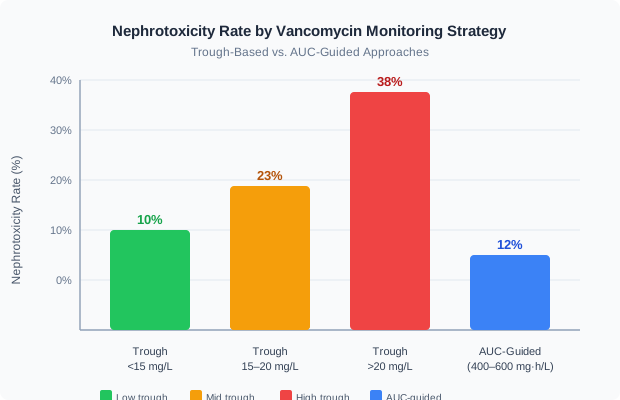
Chasing a trough of 15–20 mg/L in a patient with a small volume of distribution could push their AUC well above 600 mg·h/L, unnecessarily increasing kidney risk. That's the core of the argument against trough-only monitoring.
See also our post on vancomycin nephrotoxicity risk factors for a deeper look at which patients carry the highest baseline risk.
The AUC/MIC Pharmacodynamic Rationale
Vancomycin's bactericidal activity correlates with the ratio of the 24-hour area under the concentration-time curve to the minimum inhibitory concentration (AUC₂₄/MIC). For S. aureus with an MIC of 1 mg/L, the most common susceptibility breakpoint, the pharmacodynamic target is an AUC₂₄/MIC ≥ 400.
Assuming an MIC of 1 mg/L, that means targeting an AUC₂₄ of 400–600 mg·h/L. The upper bound of 600 mg·h/L is where nephrotoxicity risk accelerates. This range gives you therapeutic efficacy while keeping the patient safer than trough-based targets did.
If your institution is still using MIC = 2 mg/L as the breakpoint, the math changes considerably, and vancomycin may not be the right agent at all. More on that in our MRSA treatment guidelines post.
How to Implement AUC Monitoring in Practice
There are two main methods for estimating AUC₂₄ at steady state:
Two-level Bayesian estimation is the preferred approach. You draw two levels, typically a peak (1–2 hours post-infusion end) and a trough, then feed them into Bayesian pharmacokinetic software. Programs like DoseMe, InsightRx, or Pharmacy computer order entry systems with built-in Bayesian modules will give you individual PK parameters and a predicted AUC. This method accounts for individual variation in Vd and clearance.
Single-trough AUC conversion is a simplified approach when two-level sampling isn't feasible. Population PK equations can estimate AUC from a steady-state trough, but the accuracy is lower. Some institutions use it as a screening tool. If the converted AUC looks clearly out of range, they'll add a second level.
Neither method works without getting the timing right. Mislabeled draw times are the most common source of error in vancomycin TDM. If a trough is drawn even an hour early, your AUC estimate will be wrong.
Practical Implications for Clinical Pharmacy
The shift to AUC monitoring changes daily pharmacy workflow in a few concrete ways:
First, you need access to Bayesian software. Many health systems have added this to their clinical decision support tools since 2020, but implementation is still uneven. If your institution hasn't yet, the ASHP guidelines recommend it explicitly.
Second, the timing of initial monitoring changes. The 2020 guidelines recommend getting a Bayesian AUC estimate after the third or fourth dose for most patients, earlier in critically ill patients or those with rapidly changing renal function. Daily monitoring is appropriate until AUC is stable; then you can extend to every 2–3 days for stable patients.
Third, dose adjustments are now driven by the AUC estimate, not the trough. If AUC is 350 mg·h/L and the trough happens to be 12 mg/L, you increase the dose, even though 12 mg/L would have been "acceptable" under the old system. Use our vancomycin dosing calculator to run those numbers.
For more background on the broader TDM framework, see our therapeutic drug monitoring guide.
When AUC Monitoring Is Most Critical
Not every patient needs Bayesian AUC monitoring. For short-course empiric therapy in a patient with normal renal function and a low-severity infection, the clinical impact of precise AUC targeting is modest. But for any of the following, AUC-guided dosing with Bayesian estimation should be standard:
- MRSA bacteremia or endocarditis
- Osteomyelitis or prosthetic joint infection
- Baseline renal impairment (CrCl < 60 mL/min)
- Concurrent nephrotoxins (NSAIDs, aminoglycosides, IV contrast)
- Prolonged therapy (> 5–7 days)
- ICU patients or those with fluid shifts
The Bottom Line
Trough-based monitoring wasn't wrong for its time, it was the best available tool. But the 2020 ASHP/IDSA/SIDP guidelines represent a genuine improvement, backed by better evidence. AUC₂₄ targeting of 400–600 mg·h/L gives you a pharmacodynamically rational endpoint with lower nephrotoxicity rates than aggressive trough targeting.
If your institution still uses trough-only monitoring for serious MRSA infections, it's worth pushing for Bayesian software access. The infrastructure investment pays off quickly in avoided AKI and avoided redosing complexity.
Ready to estimate AUC for your patient? Use our vancomycin AUC dosing calculator to get a personalized dose recommendation based on 2020 guideline targets.