Vancomycin Dosing in Renal Impairment: A Guide
Vancomycin renal dosing requires matching dose intervals to CrCl, learn the four thresholds, dialysis adjustments, and when to call pharmacy.
Quick Answer: Adjust the interval, not the dose. The ASHP/IDSA 2020 guidelines recommend q8h for CrCl ≥90 mL/min, q12h for 50–89, q24h for 20–49, and q48h (or based on levels) for CrCl <20 mL/min. Hemodialysis patients are dosed after each session based on post-HD levels.
Vancomycin renal dosing is one of the highest-stakes adjustments in hospital pharmacy. Get it wrong and you're either undertreating a serious infection or pushing a patient toward acute kidney injury. Renal function isn't just one factor among many here, it's the primary driver of how the drug is cleared.
The dosing framework in this guide follows the 2020 ASHP/IDSA/PIDS/SIDP consensus (Rybak MJ et al., Pharmacotherapy 2020;40(13):1280–1315), which replaced earlier trough-only targets with AUC-guided monitoring and refined the CrCl interval thresholds most hospitals now use.
Why Vancomycin Accumulates in Renal Impairment
Vancomycin is eliminated almost entirely by the kidneys. Roughly 90–95% of a dose is excreted unchanged in the urine via glomerular filtration. There's no significant hepatic metabolism, no biliary excretion, and no clinically relevant non-renal clearance pathways in most patients.
That means when renal function declines, vancomycin half-life extends dramatically. In a patient with normal kidneys (CrCl ~100 mL/min), the half-life is 4–8 hours. In end-stage renal disease without dialysis, it stretches to 7–9 days. If you keep dosing q12h in a patient with a CrCl of 15 mL/min, you'll accumulate toxic concentrations within 24–48 hours.
The Four CrCl Thresholds and Dosing Intervals
Standard vancomycin dosing intervals map to creatinine clearance in a stepwise fashion. These are general population PK estimates, individual Bayesian titration is always preferred when available. See our post on trough versus AUC monitoring for why Bayesian estimation matters.
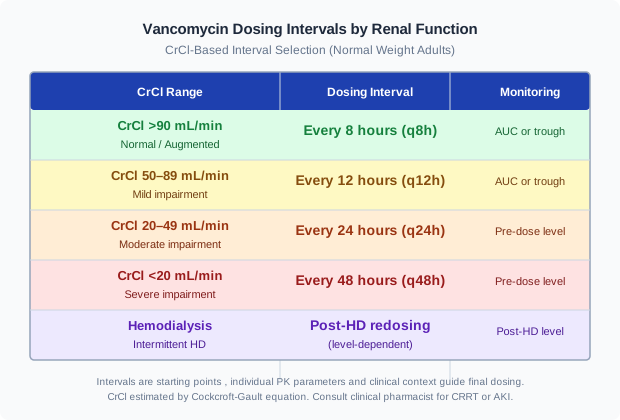
CrCl > 90 mL/min: Every 8 hours (q8h). Standard dosing for patients with normal or near-normal renal function. Initial dose typically 15–20 mg/kg actual body weight; total daily dose often 45–60 mg/kg/day in divided doses.
CrCl 50–89 mL/min: Every 12 hours (q12h). Mild renal impairment still allows reasonable clearance, but the interval extends to avoid accumulation. Most non-critically ill patients fall here.
CrCl 20–49 mL/min: Every 24 hours (q24h). Moderate impairment. At this level, the drug's half-life has approximately doubled from normal. Troughs and AUC must be closely monitored after the second or third dose.
CrCl < 20 mL/min: Every 48 hours (q48h) or longer. Severe impairment approaching ESRD. Some clinicians prefer to give a single dose and repeat only after confirming levels have dropped to a safe pre-dose concentration. Empiric q48h can be used but should be confirmed with drug levels.
These thresholds are starting points. Don't use the interval alone as your endpoint, use levels to guide all subsequent dosing decisions. Run the numbers with our vancomycin dosing calculator before writing orders.
Hemodialysis Patients
Hemodialysis (HD) removes vancomycin to a variable degree depending on the membrane used. With conventional low-flux dialyzers, clearance is minimal, roughly 10–20% per session. High-flux membranes clear considerably more, often 30–50%.
The standard approach for intermittent HD:
1. Give a loading dose of 25 mg/kg before or after the first dialysis session.
2. Redose 500–1000 mg after each HD session for patients on high-flux membranes.
3. For low-flux membranes, check a level 6 hours post-dialysis; redose if below 10–15 mg/L.
4. Never give vancomycin during dialysis unless you account for the removal, you'll miss your target.
Don't assume a fixed post-HD dose will work for every patient. Body weight, residual renal function (if any), and membrane type all matter.
Continuous Renal Replacement Therapy (CRRT)
CRRT is more complex than intermittent HD because clearance is continuous, depends on effluent flow rates, and varies by modality (CVVH, CVVHD, CVVHDF). Vancomycin clearance during CRRT typically runs 15–30 mL/min, but this varies.
A starting point sometimes used is 1000–1500 mg every 24 hours, but CRRT patients are usually critically ill with rapidly changing fluid status and hemodynamics. The practical answer here: involve clinical pharmacy early, run Bayesian estimates whenever possible, and check levels every 24–48 hours. Don't rely on population PK alone for CRRT dosing.
Acute Kidney Injury Considerations
AKI presents a unique challenge because renal function isn't static, it can decline over hours. A CrCl of 45 mL/min at 8 AM might be 25 mL/min by the next morning in a septic patient.
Key points for AKI:
- Recalculate CrCl every 12–24 hours in patients with active AKI.
- Use the most recent serum creatinine, don't dose based on a value from admission if it's 48 hours old.
- In oliguria, assume near-ESRD clearance until proven otherwise.
- If creatinine is rising rapidly, consider holding scheduled doses until you have a level.
The biggest vancomycin errors in AKI patients come from using stale creatinine values. Build the habit of checking the timestamp on the creatinine you're using to calculate CrCl.
When to Consult Pharmacy
Most clinical teams can handle standard dose adjustments with a CrCl-based table. But pharmacy consultation is appropriate, and often essential, in these situations:
- CrCl < 20 mL/min without dialysis
- Any form of renal replacement therapy
- Rapidly changing renal function (AKI on ICU admission, post-cardiac surgery)
- Suspected vancomycin-induced nephrotoxicity
- Concurrent nephrotoxins (aminoglycosides, tacrolimus, IV contrast within 24 hours, NSAIDs)
- Morbid obesity (BMI > 40) where weight-based dosing is unclear
- Prior vancomycin exposure with documented levels available
Getting pharmacy involved isn't a sign that something went wrong, it's how you avoid something going wrong. Our about page describes the clinical framework behind this calculator if you want more context on the approach.
Putting It Together
Vancomycin renal dosing is an area where clinical pharmacists earn their keep. The four-threshold interval guide is a starting framework, but it's not a substitute for real drug levels and thoughtful Bayesian interpretation. Every patient with significant renal impairment deserves a level-based adjustment plan before the third dose.
Use our vancomycin renal dosing calculator to calculate an individualized dose based on your patient's current CrCl, weight, and clinical context.