Why Vancomycin Needs a Loading Dose
A vancomycin loading dose of 25–30 mg/kg achieves therapeutic concentrations immediately, without waiting 3–4 maintenance doses to reach steady state.
Quick Answer: A 25–30 mg/kg loading dose based on actual body weight (cap 3,000 mg) is standard for seriously ill adults. The rationale is pharmacokinetic: vancomycin's volume of distribution (0.7 L/kg) means maintenance-only dosing takes 24–48 hours to reach the 400 mg·h/L AUC target, a delay septic patients can't afford.
A vancomycin loading dose is one of the most evidence-backed interventions in serious infection management, yet it's still frequently omitted. In patients with sepsis, endocarditis, or bacteremia, the first few hours of treatment matter. Waiting for steady-state concentrations is not an option.
What a Loading Dose Does Pharmacokinetically
Any drug with a large volume of distribution (Vd) takes time to reach steady state. Vancomycin's Vd is approximately 0.5–1 L/kg, meaning the drug distributes widely into tissues before equilibrating in plasma. With a typical half-life of 6–8 hours in a patient with normal renal function, full steady state takes four to five half-lives, or roughly 24–40 hours.
If you start at a maintenance dose and wait, you're undertreating your patient for the first full day. A loading dose saturates the volume of distribution immediately, so plasma concentrations reach the therapeutic AUC₂₄ target of 400–600 mg·h/L from the first dose rather than after 3–4 administrations.
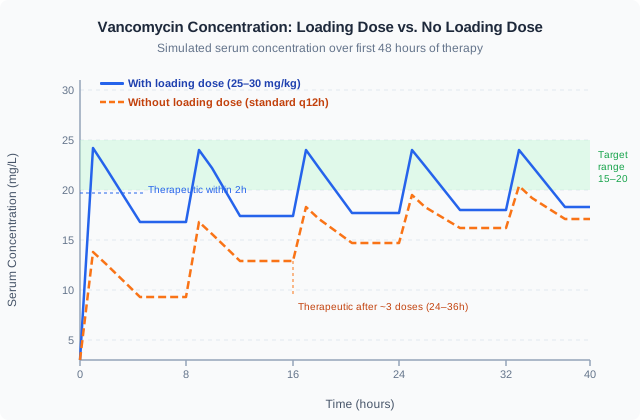
The pharmacokinetic argument is straightforward. The loading dose is calculated for Vd, not for clearance, it fills the compartment. Maintenance doses then replace what's eliminated each interval.
The 25–30 mg/kg Recommendation
The 2020 ASHP/IDSA/SIDP consensus guidelines recommend a loading dose of 25–30 mg/kg based on actual body weight (ABW), with a cap of 3000 mg per the guideline to limit infusion-related reactions and over-exposure. Rybak MJ et al. (Pharmacotherapy 2020;40(13):1280–1315) is the full reference behind this recommendation, and it's the same document your hospital P&T committee likely adopted as the institutional vancomycin protocol.
For a 90 kg patient: 25 mg/kg × 90 kg = 2250 mg. That's your loading dose. Maintenance dosing then depends on renal function, a separate calculation. Use our vancomycin loading dose calculator to run through both steps for your specific patient.
In obese patients (BMI > 40), the cap matters more. A 130 kg patient at 30 mg/kg would be 3900 mg, well above the 3000 mg ceiling. The safety concern is infusion-related reactions and hitting supratherapeutic AUC early. Use 3000 mg as the hard upper limit.
Who Benefits Most: Critically Ill Patients
The loading dose argument is most compelling in:
Sepsis and septic shock. Hemodynamic instability and fluid resuscitation expand Vd, which dilutes drug concentrations further. Loading doses are often underdosing in septic patients even at 25–30 mg/kg, some PK models suggest 30 mg/kg is the better starting point in ICU patients.
Infective endocarditis. Valve vegetations have poor penetration characteristics. Getting to therapeutic AUC quickly reduces the window where bacteria can proliferate in a protected niche. IDSA endocarditis guidelines explicitly recommend loading doses.
MRSA bacteremia. Every hour of subtherapeutic vancomycin exposure in bacteremia correlates with persistent bacteremia and increased mortality in observational data.
Meningitis. CNS penetration is only 7–14% of serum concentration for vancomycin. You need high serum concentrations to push adequate drug into CSF, that starts with a proper loading dose.
See our MRSA treatment guidelines for the full picture of site-specific dosing targets.
Infusion Rate and Red Man Syndrome
Vancomycin causes infusion-related reactions, classically "Red Man Syndrome" (RMS), characterized by flushing, erythema of the face and neck, and sometimes hypotension. RMS is not a true allergic reaction; it's a direct mast cell degranulation response to rapid infusion.
The rate-based guideline: no more than 500 mg per 30 minutes, or equivalently, infuse at ≤ 10 mg/min. A 2500 mg loading dose must run over at least 150 minutes (2.5 hours). Many institutions round up to 3 hours for loading doses to add safety margin.
If a patient has had prior RMS with vancomycin, pretreatment with diphenhydramine 25–50 mg IV 30 minutes before infusion helps blunt the reaction. Slowing the rate further is equally effective.
Don't let concerns about infusion time be a reason to skip the loading dose. A 2.5–3 hour infusion is appropriate, plan the schedule around it.
When to Skip or Modify the Loading Dose
Not every patient needs or tolerates a loading dose:
Recent prior vancomycin dose. If the patient received vancomycin within the past 12–24 hours (e.g., at an outside hospital), check a level first. A loading dose on top of active drug could push AUC well above 600 mg·h/L.
Severe renal impairment. In patients with CrCl < 10 mL/min or on dialysis, the half-life is so extended that even the maintenance dose may constitute a functional loading dose. A 25 mg/kg loading dose in a patient with near-zero clearance can persist for days. Some clinicians still use a reduced loading dose (15–20 mg/kg) in this setting; others prefer to rely on levels to guide the first dose.
Known vancomycin toxicity or prior hypersensitivity. If there's documented prior anaphylaxis (distinct from RMS), vancomycin is contraindicated regardless of dose.
Mild, non-critical infections in outpatient or OPAT settings. If you have days to titrate and the infection isn't life-threatening, the urgency of immediate therapeutic concentrations is lower. That said, many OPAT protocols still use loading doses for efficiency.
Monitoring After the Loading Dose
A loading dose is not a "set it and forget it" step. After the loading dose:
- Draw the first PK levels after the second or third maintenance dose (steady-state monitoring), not after the loading dose itself, the loading dose creates a transient peak that's not informative for AUC estimation.
- In critically ill patients with rapid fluid shifts, check a level 6–12 hours post-loading to catch early over- or under-exposure.
- Adjust maintenance based on AUC estimation, not on re-giving a loading dose. Loading doses are given once; if levels drop too low, adjust the maintenance interval or dose size.
For a full explanation of AUC-based monitoring and why it matters, see our post on vancomycin AUC monitoring. For specific nephrotoxicity monitoring parameters after loading, see the vancomycin nephrotoxicity post.
The Takeaway
The loading dose is part of guideline-directed therapy for serious MRSA infections. Skipping it, usually out of concern for nephrotoxicity, often backfires: patients remain subtherapeutic for 24+ hours, and empiric therapy fails before levels are even checked.
Use the 25–30 mg/kg ABW recommendation (cap at 3000 mg), infuse over at least 150 minutes per 2500 mg dose, and follow with level-guided maintenance dosing. The pharmacokinetics are on your side when you do it right.
Calculate your patient's loading and maintenance doses using our vancomycin calculator, it walks through both steps with 2020 ASHP guideline targets built in.