Vancomycin TDM: When and How to Check Levels
Vancomycin therapeutic drug monitoring with AUC estimation requires knowing when to draw levels, how to interpret them, and when to bring in Bayesian software.
Quick Answer: Draw two levels at steady state (third or fourth dose) for Bayesian AUC estimation: a peak 1–2 hours post-infusion and a pre-dose trough. Target AUC₂₄ of 400–600 mg·h/L. If Bayesian software isn't available, use population PK equations with a single trough, but accept that accuracy is lower.
Vancomycin therapeutic drug monitoring sounds straightforward until you're standing in front of a patient whose level was drawn at the wrong time, whose renal function changed overnight, and whose AUC estimate is anything but clear. Getting TDM right requires more than ordering a level, it requires knowing when to draw it, how to use it, and what to do when the number doesn't match your expectation.
Why Vancomycin Needs TDM
Most antibiotics don't require routine blood level monitoring. Amoxicillin, ceftriaxone, azithromycin, you select the dose from a package insert, use it, and don't check drug concentrations unless something goes wrong. Vancomycin is different for two reasons.
First, the therapeutic index is narrow. The target AUC₂₄ range of 400–600 mg·h/L sits between two clear failure modes: underdosing (AUC <400, increased risk of clinical failure and potential resistance selection) and overdosing (AUC >600, substantially higher nephrotoxicity risk). That 200 mg·h/L window is narrow enough that population-based dosing frequently misses it in individual patients.
Second, inter-patient variability in vancomycin clearance is substantial. Vancomycin is renally eliminated almost entirely by glomerular filtration. Creatinine clearance varies by age, weight, sex, muscle mass, hydration status, and underlying disease, sometimes dramatically in the same patient over the course of an ICU admission. A dose appropriate on day 1 may be 30–40% too high or too low by day 5.
TDM is the mechanism for catching that drift before it causes harm. The 2020 ASHP/IDSA/SIDP consensus guidelines established AUC-guided TDM as the standard of care, a shift from the earlier trough-only approach that failed to prevent nephrotoxicity because it couldn't accurately quantify total drug exposure. See our comparison of trough vs AUC monitoring approaches for the clinical evidence behind this transition.
When to Initiate TDM
The standard recommendation: draw levels after the 3rd or 4th dose in patients with stable renal function. This ensures you're at or near pharmacokinetic steady state, which for vancomycin occurs after approximately 4–5 half-lives. In a patient with normal renal function and a half-life of 6–8 hours, steady state arrives within 24–40 hours.
Several situations call for earlier TDM:
- Changing renal function: any patient whose creatinine is trending upward (or downward) should have levels drawn sooner, ideally after the 2nd dose if creatinine is rising rapidly
- Critically ill patients: hemodynamic instability, vasopressors, and fluid shifts all alter vancomycin distribution and clearance in ways that population PK models don't reliably capture
- Extremes of renal function: CrCl <20 mL/min (much longer half-life, levels need to guide interval extension) or >130 mL/min (augmented renal clearance, standard doses may be subtherapeutic)
- Obesity (BMI >40 kg/m²): altered volume of distribution and variable renal clearance mean population PK estimates are particularly unreliable
- Dialysis-dependent patients: conventional dosing schedules don't apply; levels guide when the next dose is needed based on residual drug exposure
Use the vancomycin dosing calculator to estimate the initial dose before TDM is available, it accounts for renal function and weight to give you a population-based starting point.
Two-Level AUC Estimation: The Right Way to Draw Levels
The most accurate bedside AUC estimation uses two concentration measurements: a peak (or mid-interval level) and a trough. This approach allows patient-specific calculation of both vancomycin clearance (Cl) and volume of distribution (Vd), the two parameters that define the full concentration-time curve.
Timing for the two-level approach:
- Draw the first level 1–2 hours after infusion completion (to avoid the distribution phase)
- Draw the second level just before the next dose (trough)
- Document exact draw times relative to dose administration, even a 30-minute error shifts AUC calculations meaningfully
With two levels and known dose information, AUC₂₄ can be calculated directly using the one-compartment model equations that underlie most Bayesian software platforms:
AUC₂₄ = (Dose / Cl) × (24 / tau)
Where Cl is derived from the two-level data. You don't need to do this by hand, Bayesian software handles it, but understanding the derivation helps you recognize when an AUC estimate is implausible.
Common errors in two-level sampling:
- Drawing the trough too early (>15 minutes before the next dose), overestimates trough, underestimates AUC
- Not accounting for infusion rate (e.g., recording infusion end time when the level was drawn before infusion completed)
- Forgetting to document the exact dose and infusion duration for that particular day, which may differ from the rest of the regimen
Single Trough-to-AUC Conversion
Two-level sampling is the standard, but not every institution has the infrastructure for it, and not every clinical scenario justifies the additional phlebotomy.
When Bayesian software isn't available and only a trough is drawn, AUC can be approximated using population PK assumptions. The most common formula in clinical use:
AUC₂₄ ≈ (Trough + Average_Cpeak) / 2 × 24
Where Cpeak is estimated from the dose, infusion rate, and population-derived Vd. This approach introduces more uncertainty than two-level sampling, the error can be ±20–30% in individual patients, but it's significantly better than relying on trough thresholds alone (e.g., "keep trough 15–20 mg/L").
Several published papers, including Neely et al. (2014, Clinical Infectious Diseases), have validated simplified AUC estimation methods from single troughs using population PK priors for routine cases. The 2020 guidelines acknowledge this as an acceptable alternative when formal Bayesian software isn't available, provided users understand the limitations.
What to Do With the AUC Result
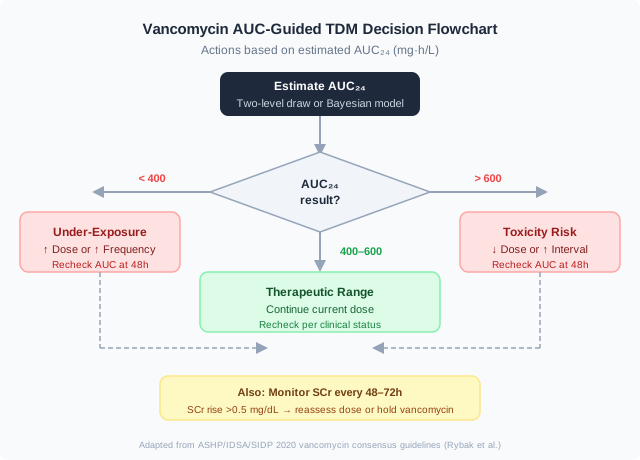
The decision framework is straightforward once you have an AUC estimate:
AUC₂₄ <400 mg·h/L: subtherapeutic. Increase the dose, increase the frequency, or both. The appropriate adjustment depends on whether the patient is trough-limited (trough looks adequate but peak and mid-interval concentrations suggest short half-life and rapid clearance) or simply underdosed. Recalculate after 2–3 doses at the new regimen.
AUC₂₄ 400–600 mg·h/L: within the therapeutic window. Continue the current regimen. Monitor per standard interval (creatinine q48–72h, repeat AUC estimation if clinical picture changes).
AUC₂₄ >600 mg·h/L: supratherapeutic. Reduce the dose, extend the interval, or both. If AUC is significantly above 600 (>700), consider holding one dose before restarting. The specific adjustment depends on how far above target you are and whether nephrotoxicity (rising creatinine) is already developing.
The vancomycin nephrotoxicity post on this site details what to do when creatinine starts rising, including when to hold, when to reduce, and when to consider switching agents entirely.
Special Populations Requiring More Frequent TDM
Standard TDM intervals (once at steady state, then as clinically indicated) apply to stable outpatients or ward patients with non-changing renal function. Several groups require more frequent reassessment:
ICU patients: hemodynamic shifts, fluid resuscitation, and vasopressor use all alter vancomycin distribution and clearance. In a patient going on and off vasopressors, AUC estimates from day 1 may be completely wrong by day 3. Repeat AUC estimation every 48–72 hours in hemodynamically unstable patients.
AKI patients: rapidly rising creatinine changes vancomycin clearance in real time. If creatinine rises ≥0.5 mg/dL over 24 hours, reassess dosing immediately. Don't wait for the next scheduled TDM.
Obese patients (BMI >40): population PK models were largely developed in normal-weight populations. Vd is higher (more lean mass, more total body water), renal clearance may be augmented, and protein binding is variable. TDM at 24 hours, even before formal steady state, can catch gross underdosing or overdosing.
Patients with severe sepsis: sepsis-induced increases in cardiac output augment renal blood flow and vancomycin clearance, often dramatically. Patients in the hypermetabolic phase of sepsis may clear vancomycin 50–100% faster than PK models predict. Check a level early.
Bayesian Software: When to Use It
Bayesian TDM software uses a population PK prior, estimated parameters from published studies, and updates that prior with patient-specific drug level data to generate individualized PK parameter estimates. It's more accurate than manual calculation for most patients and dramatically more accurate in patients with unstable or unusual PK.
Three platforms see regular clinical use:
DoseMeRx: web-based, widely used in US hospital systems, integrates with major EHR platforms. Supports two-level and single-level input. Produces both AUC estimates and dose recommendations with predicted AUC for proposed regimens.
InsightRX: cloud-based, strong real-time integration with EHR labs, includes NICU-specific models for neonatal vancomycin, an area where standard adult PK models fail entirely.
Tucuxi: open-source, used more in academic and European centers, allows more transparent model inspection.
All three produce AUC estimates with confidence intervals, a feature that manual calculation can't match. The confidence interval matters clinically: a point estimate of AUC 420 mg·h/L with a 90% CI of 380–460 mg·h/L is reassuring; the same point estimate with a CI of 310–540 mg·h/L suggests the data are insufficient for confident dosing decisions, and a second level should be drawn.
The 2020 ASHP/IDSA guidelines recommend Bayesian software as the preferred method for AUC estimation. Manual two-level calculation is an acceptable alternative; single-trough estimation is acceptable when neither is feasible. The key is getting the AUC, one way or another, rather than reverting to trough-only monitoring.
Ready to estimate your patient's AUC and identify an appropriate starting dose? Use the vancomycin AUC calculator, enter body weight, renal function, and any available drug levels, and it walks through the pharmacokinetic calculation so you can make an informed dosing decision. Learn more about the clinical team behind this tool.