Vancomycin Nephrotoxicity: Risks, Prevention, Monitoring
Vancomycin nephrotoxicity affects 5–43% of patients depending on risk factors. Learn which patients are at highest risk and how AUC-guided monitoring reduces kidney injury.
Quick Answer: Vancomycin nephrotoxicity rises sharply above AUC₂₄ of 600 mg·h/L or trough >20 mg/L. The strongest modifiable risk factors are concurrent piperacillin-tazobactam, aminoglycosides, and contrast exposure. Monitor serum creatinine every 48–72 hours and recalculate dosing if CrCl shifts by more than 15–20%.
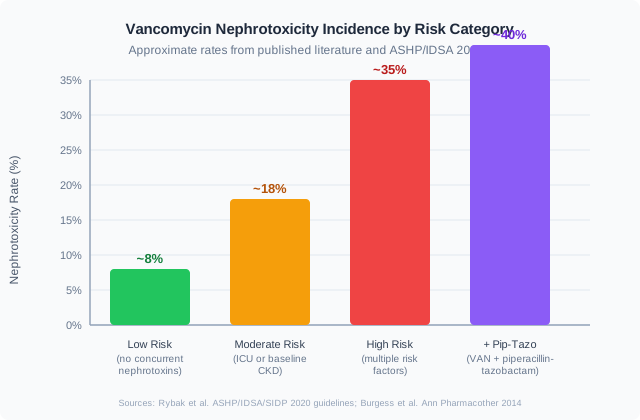
Vancomycin nephrotoxicity is one of the most common drug-induced kidney injuries in hospitalized patients. Reported incidence ranges from 5% in low-risk outpatients to 43% in critically ill patients with multiple nephrotoxin exposures. That wide range isn't noise, it reflects real differences in patient populations and how nephrotoxicity is defined.
Understanding who's at risk and how to monitor appropriately is what separates a course of vancomycin that stays on track from one that ends with an AKI consult.
How Vancomycin Damages the Kidney
The mechanism isn't fully settled, but oxidative stress on proximal tubular cells appears central. Vancomycin accumulates in tubular epithelial cells via megalin-mediated endocytosis, generating reactive oxygen species and triggering mitochondrial dysfunction. The result is tubular necrosis, typically reversible if caught early, but capable of progressing to sustained AKI if exposure continues unchecked.
What's become clear over the past decade is that total drug exposure, expressed as AUC₂₄, predicts nephrotoxicity better than any single trough level. An AUC₂₄ consistently above 600 mg·h/L significantly increases the risk of kidney injury, regardless of what the trough looks like in isolation. This is why the 2020 ASHP/IDSA/SIDP consensus guidelines moved away from trough-only targets and toward AUC-guided monitoring. You can read more about the trough versus AUC debate in our post on vancomycin trough vs AUC monitoring.
The AUC >600 mg·h/L Threshold
The relationship between AUC and nephrotoxicity was clarified by several key analyses. Lodise et al. (2009, Antimicrobial Agents and Chemotherapy) found that trough levels ≥15 mg/L were independently associated with nephrotoxicity. But troughs are a proxy for AUC, and a crude one. Subsequent Bayesian modeling studies showed AUC₂₄ >600 mg·h/L as the cleaner predictor.
In the 2020 guidelines, the recommended target AUC₂₄ for serious MRSA infections is 400–600 mg·h/L. The lower bound ensures efficacy; the upper bound minimizes nephrotoxicity. Staying within that window requires either two-level AUC estimation or Bayesian dosing software, not a single trough drawn at the wrong time.
The practical implication: if a patient's AUC is estimated at 650 mg·h/L and the trough looks acceptable at 14 mg/L, that's still a signal to reduce the dose or extend the interval. The trough alone would have kept you in the dark.
Concurrent Nephrotoxins: The Highest-Risk Combinations
Vancomycin in isolation carries moderate nephrotoxic risk. Combine it with another nephrotoxin and that risk multiplies substantially.
Piperacillin-tazobactam is the most clinically relevant combination. Multiple retrospective studies and two meta-analyses found that VAN + pip-tazo carries nephrotoxicity rates of 35–40%, compared to 10–15% for vancomycin with cefepime or meropenem. The ACORN trial (2023, JAMA) prospectively confirmed this: pip-tazo increased AKI risk by roughly 3-fold versus ceftriaxone when combined with vancomycin. If there's a gram-negative coverage alternative that's appropriate for the clinical situation, it's worth using it.
Aminoglycosides add additive tubular toxicity. Gentamicin, tobramycin, and amikacin all damage the same proximal tubular cells. If both are needed, for example, gentamicin added for bactericidal combination therapy in enterococcal endocarditis, monitor creatinine every 24–48 hours rather than every 48–72 hours.
NSAIDs reduce renal perfusion via prostaglandin inhibition. In a patient receiving vancomycin for a serious infection, routine NSAID use should be discontinued if at all possible. This includes ketorolac.
IV contrast poses an additive risk within 24–48 hours of administration. If a CT with contrast is ordered for a patient on vancomycin with any degree of baseline renal impairment, timing matters.
Patient-Level Risk Factors
Beyond concurrent drugs, certain patient characteristics increase baseline susceptibility to vancomycin nephrotoxicity:
- Baseline CKD (eGFR <60 mL/min): reduced tubular reserve, slower clearance leading to higher AUC accumulation
- ICU admission: hemodynamic instability reduces renal perfusion independent of drug exposure
- Diabetes mellitus: microvascular disease limits tubular regenerative capacity
- Hypoalbuminemia (albumin <2.5 g/dL): altered protein binding changes free drug fraction, though the clinical impact on nephrotoxicity specifically is debated
- Prolonged therapy (>7 days): cumulative tubular injury accumulates over time
- Higher doses: patients requiring >4 g/day consistently show higher nephrotoxicity rates in observational data
In a patient with three or more of these factors, the nephrotoxicity risk approaches or exceeds 35% even without concomitant nephrotoxins. These patients deserve early Bayesian-guided dosing, not empiric dosing with first-level TDM at day 3.
Monitoring Strategy: What to Check and When
The 2020 consensus guidelines recommend checking serum creatinine every 48–72 hours during vancomycin therapy. In high-risk patients, ICU, AKI, concurrent nephrotoxins, every 24–48 hours is more appropriate.
A rise in serum creatinine of ≥0.5 mg/dL above baseline (or ≥50% increase) on two consecutive measurements meets the KDIGO definition for AKI stage 1. That's your trigger to act, not your trigger to watch more closely.
When creatinine rises:
1. Reassess the AUC estimate. A rising creatinine often indicates accumulation, recalculate with updated levels.
2. Extend the dosing interval or reduce the dose. If AUC is above 600, reduce. If AUC is within range but creatinine is rising, consider whether other nephrotoxins can be removed first.
3. Hold vancomycin if creatinine has doubled or oliguria develops. Check a level before resuming. Don't redose into an AUC you can't estimate.
4. Consider switching agents if the infection can be treated with an alternative. For MRSA bacteremia, daptomycin is the most common switch; it's not nephrotoxic at standard doses.
Use our vancomycin dosing calculator to re-estimate AUC when you have an updated creatinine or new drug levels, it recalculates clearance from current renal function, which is exactly what you need when the clinical picture is changing.
Is Vancomycin Nephrotoxicity Reversible?
Generally, yes, if it's caught early. Studies tracking recovery of renal function after vancomycin discontinuation show that most patients return to within 0.3 mg/dL of baseline creatinine within 7–14 days. The key phrase is "if caught early." Patients who continue receiving vancomycin for several days after AKI onset, either because levels weren't checked or because the creatinine rise was attributed to other causes, have worse recovery trajectories.
In practice, this means that a systematic approach to monitoring matters more than any individual clinical decision. Checking creatinine every 48–72 hours isn't optional; it's the mechanism by which reversibility is preserved.
Patients who develop AKI requiring dialysis during vancomycin therapy represent a small but serious subset. Continuous renal replacement therapy dramatically alters vancomycin pharmacokinetics, making TDM even more critical. Consult with nephrology and clinical pharmacy early in these cases.
Putting It Together: A Risk-Stratified Approach
Not every patient on vancomycin needs the same monitoring intensity. A 35-year-old with normal renal function, no concurrent nephrotoxins, and a 5-day course for a skin infection is at low risk, baseline creatinine and one set of levels at steady state is reasonable.
A 68-year-old with CKD stage 3, receiving vancomycin plus pip-tazo in the ICU for a hospital-acquired pneumonia is at high risk. That patient needs Bayesian-guided dosing from day one, creatinine checks every 24–48 hours, and a low threshold to switch antibiotics if AKI develops.
The therapeutic drug monitoring guide on this site walks through exactly how to time and interpret vancomycin levels for AUC estimation, including what to do when renal function is changing.
AUC-guided dosing was adopted precisely because it gives you a real-time picture of total drug exposure, not just a snapshot of trough levels. Use it to keep your patients in the 400–600 mg·h/L target range, and nephrotoxicity rates will be substantially lower than the historical averages associated with trough-only monitoring.
Ready to calculate a dose? Use our vancomycin AUC calculator to estimate AUC, adjust for renal function, and flag when a patient's exposure is heading toward the nephrotoxic range. You can find more about the clinical team and methodology on our about page.