Vancomycin Dosing in Obese Patients: TBW vs IBW
Vancomycin dosing in obese patients depends on which body weight to use for loading and maintenance. AUC-guided TDM matters more here than in any other population.
Quick Answer: Load with 25 mg/kg actual body weight (cap 3,000 mg) even in obesity. For maintenance, start with 15 mg/kg total body weight q8–12h and let TDM drive adjustment. Use total body weight in the Cockcroft-Gault equation for CrCl. Draw AUC levels after the second or third dose because clearance is harder to predict.
Vancomycin dosing in obese patients is one of the most practically challenging areas in antimicrobial pharmacokinetics. It's not that obesity creates a unique PK profile, it's that all the variables you need to estimate dose are simultaneously less reliable. Body weight is higher, but which weight matters? Renal function looks adequate on paper, but creatinine may not reflect true GFR. Population PK models may not apply. The result is that a dose calculated in the usual way is often wrong in a way you can't predict from the clinical data alone.
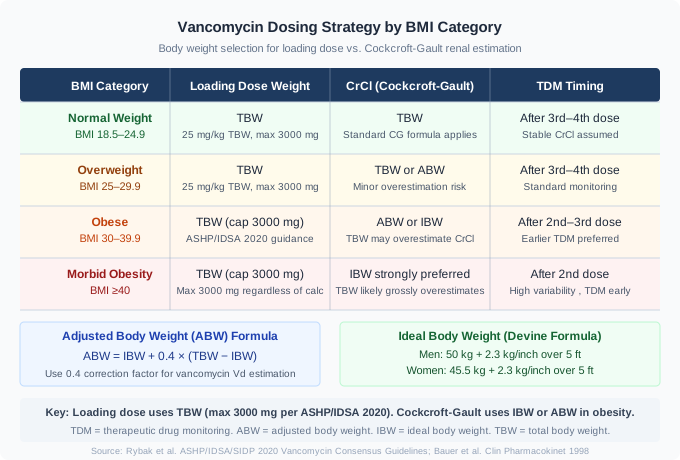
Why Obesity Complicates Vancomycin Pharmacokinetics
Three mechanisms drive PK variability in obesity:
Volume of distribution is increased. Vancomycin distributes into extracellular fluid, lean tissue, and, to some degree, adipose tissue. As body weight increases, total Vd increases roughly proportionally to total body weight up to a point. Studies by Bauer et al. (1998, Clinical Pharmacokinetics) and subsequent analyses have consistently found Vd of approximately 0.7 L/kg TBW in obese patients, similar to non-obese patients on a per-kilogram basis, but substantially higher in absolute terms. This means that loading doses based on ideal body weight will achieve lower peak concentrations than intended.
Renal clearance may be increased, normal, or decreased, often depending on the type of obesity and comorbidities. Obese patients without diabetes or chronic kidney disease often have hyperfiltration due to increased renal perfusion, leading to augmented vancomycin clearance and shorter effective half-lives. The implication: standard dosing intervals (q12h or q8h) may be insufficient, and some patients need q6h dosing. Conversely, obese patients with diabetic nephropathy or hypertensive nephrosclerosis may have significantly reduced clearance. You cannot assume renal function from the body habitus alone.
Creatinine as a surrogate for GFR is unreliable. Creatinine is a product of muscle metabolism. Lean mass, not fat mass, is what generates creatinine. A 130 kg patient with a normal serum creatinine of 0.9 mg/dL may have very different GFR depending on whether those 130 kg include substantial lean mass (muscular obesity) or substantial adipose mass with relatively reduced muscle (sarcopenic obesity). The Cockcroft-Gault equation with actual body weight in this patient will overestimate GFR; using IBW may underestimate it.
TBW, IBW, and ABW: Definitions and When to Use Each
These three weight measures appear constantly in clinical discussions, and using the wrong one in the wrong context produces meaningful dosing errors.
Total body weight (TBW) is the patient's actual weight. It's appropriate for vancomycin loading dose calculations per the 2020 ASHP/IDSA guidelines and for estimating Vd.
Ideal body weight (IBW) represents estimated lean body mass using height. The standard Devine formula:
- Men: IBW = 50 kg + 2.3 kg per inch above 5 feet
- Women: IBW = 45.5 kg + 2.3 kg per inch above 5 feet
IBW is used as the basis for ABW calculation and for Cockcroft-Gault in some dosing contexts (see below). Don't use IBW alone for vancomycin loading dose, it underestimates Vd in obese patients.
Adjusted body weight (ABW) accounts for the partial contribution of adipose tissue to drug distribution:
ABW = IBW + 0.4 × (TBW − IBW)
The 0.4 correction factor is empirically derived, 40% of excess weight is added back to IBW. For many drugs, ABW is the most appropriate weight for dose-per-kilogram calculations in obese patients. For vancomycin specifically, however, the 2020 guidelines recommend TBW for loading doses, the evidence supports using actual weight for the initial load, not ABW.
ASHP/IDSA 2020 Recommendation for Loading Dose
The 2020 ASHP/IDSA/SIDP consensus guidelines recommend loading dose calculation based on TBW at 25 mg/kg, with a maximum of 3000 mg per single dose regardless of weight.
So for a 150 kg patient: 25 mg/kg × 150 kg = 3750 mg, but this is capped at 3000 mg. Infuse over at least 2–3 hours (some institutions use rate-based limits of ≤10–15 mg/min) to minimize infusion-related reactions.
The 3000 mg cap exists not because higher loads are pharmacokinetically wrong, but because clinical evidence supporting doses above 3000 mg is sparse, and the risk of infusion-related reactions and acute nephrotoxicity from the loading dose itself rises with rapid, high-dose administration.
After the loading dose, maintenance dosing should target AUC₂₄ 400–600 mg·h/L using TDM from the second dose onward. The loading dose gets you to therapeutic concentrations quickly; TDM keeps you there accurately.
Maintenance Dosing in Obesity: Why TDM Matters Most Here
Population PK models for vancomycin maintenance dosing were largely developed in studies that either excluded obese patients or used them in small proportions. The practical consequence: standard dosing nomograms, even those adjusted for renal function, are less reliable in patients with BMI >40 kg/m².
This is the population where early, aggressive TDM pays off most. Draw your first AUC-guided levels after the 2nd or 3rd dose, not after the 4th. Given the altered Vd and variable clearance, you're more likely to be outside the target range before steady state than in a normal-weight patient.
For AUC estimation in obese patients, two-level sampling (peak + trough) is preferred over single-trough methods. Single-trough AUC estimation relies on population PK parameters that are less accurate in obesity; two-level data lets you calculate patient-specific Cl and Vd directly. Bayesian software platforms like DoseMeRx and InsightRX have obesity-specific models that perform better than generic models, worth using if available.
Use the vancomycin dosing calculator to get a population-based starting point before TDM results are available. Enter TBW, age, sex, and current serum creatinine, then adjust once you have levels in hand.
Cockcroft-Gault in Obesity: Which Weight to Use
The Cockcroft-Gault equation:
CrCl = [(140 − age) × weight × (0.85 if female)] / (72 × SCr)
The weight variable here is where institutions and clinicians disagree.
Using TBW in obese patients overestimates CrCl because the equation was validated primarily in non-obese populations, and obese patients often have serum creatinine that's lower than expected for their GFR (due to reduced muscle mass relative to fat mass). Plugging TBW into the equation amplifies both sources of error.
The most common institutional approaches:
- Use IBW for patients with BMI >30 if TBW significantly exceeds IBW, this avoids the overestimation but may underestimate CrCl in muscular obese patients
- Use ABW as a compromise, recommended by some guidelines including ASHP's dosing recommendations for aminoglycosides, and extrapolated to vancomycin by some clinicians
- Use the lower of TBW or IBW, conservative approach that avoids gross overdosing
The ASHP/IDSA 2020 vancomycin guidelines don't specify a single weight for Cockcroft-Gault in obesity, acknowledging the evidence gap. Most clinical pharmacists with experience in obesity dosing default to ABW or IBW for CG, while using TBW for Vd-based calculations (i.e., loading dose). Read more about the Cockcroft-Gault equation and its variables in detail, the choice of weight input substantially affects the CrCl estimate.
Serum Creatinine Pitfalls: Muscular Obese vs Sarcopenic Obese
These two patient types have opposite creatinine problems:
Muscular obese patients (e.g., former athletes, patients with substantial lean mass despite high BMI): creatinine production is high, serum creatinine may be 1.2–1.5 mg/dL even with entirely normal GFR. Using this creatinine in Cockcroft-Gault will underestimate CrCl, leading to a longer dosing interval and potentially underdosing.
Sarcopenic obese patients (elderly obese patients with significant muscle wasting): low muscle mass generates very little creatinine. Serum creatinine may be 0.6–0.7 mg/dL despite substantially reduced GFR, perhaps as low as 40–50 mL/min. Using this "normal" creatinine in Cockcroft-Gault will dramatically overestimate CrCl and lead to a maintenance dosing frequency that accumulates drug.
In elderly sarcopenic obese patients specifically, creatinine-based CrCl estimation is so unreliable that early TDM after the 2nd dose is arguably the only safe approach to vancomycin dosing. Don't trust the Cockcroft-Gault estimate for scheduling your first level draw, use TDM to verify clearance directly.
The Practical Approach: Calculate, Dose, Monitor Aggressively
Pulling this together into a clinical workflow:
1. Calculate IBW and TBW. If TBW > 1.2 × IBW, this patient qualifies as obese for dosing purposes.
2. Loading dose: 25 mg/kg TBW, cap at 3000 mg. Infuse over 2–3 hours.
3. Estimate CrCl for maintenance dosing interval: use ABW or IBW in Cockcroft-Gault, not TBW. Flag if serum creatinine seems discordant with clinical muscle mass.
4. Draw two-level TDM after the 2nd or 3rd dose, don't wait for the 4th in high-risk patients (ICU, AKI risk, BMI >45).
5. Adjust to AUC 400–600 mg·h/L based on measured levels. Repeat TDM at 48–72 hours if the initial estimate required significant dose adjustment.
The therapeutic drug monitoring guide on this site walks through the full AUC estimation process, including what to do when levels come back outside range, and applies directly to the obese dosing scenario.
Obesity doesn't break vancomycin pharmacokinetics. It just makes the variables less predictable. Dose empirically using TBW for loading, estimate CrCl conservatively for maintenance, and let early TDM do the work of landing, and staying, in the 400–600 mg·h/L target range. Use the estimate your vancomycin dose tool to get the initial calculation right, then trust your levels to confirm.