Cockcroft-Gault vs CKD-EPI for Vancomycin Dosing
The Cockcroft-Gault equation remains the standard for vancomycin dosing, not CKD-EPI, because it was used in the original vancomycin PK studies.
Quick Answer: Use Cockcroft-Gault, not CKD-EPI, for vancomycin dosing. The 2020 ASHP/IDSA guidelines explicitly recommend CG because every vancomycin pharmacokinetic model was built on CG-derived clearance. CG = ((140−age) × weight) ÷ (72 × SCr), then × 0.85 for females.
The Cockcroft-Gault equation is a 1976 formula that still drives vancomycin dosing in 2026, not because it's the most accurate measure of kidney function, but because it's the one the pharmacokinetic studies used. That distinction matters more than most clinicians realize.
The Cockcroft-Gault Formula
The full equation:
CrCl (mL/min) = [(140 − age) × weight (kg)] / [72 × serum creatinine (mg/dL)]
For female patients, multiply the result by 0.85.
The variables: patient age in years, body weight in kg, and serum creatinine in mg/dL. That's it. No race adjustment, no biomarker correction. It was derived in 1976 from 249 male patients aged 18–92 and has been the pharmacy standard ever since.
The weight term is the variable that creates the most clinical controversy, more on that below.
Why CG, Not CKD-EPI or MDRD, for Vancomycin
CKD-EPI (Chronic Kidney Disease Epidemiology Collaboration) is a more accurate estimate of true GFR, particularly at higher levels of kidney function. MDRD (Modification of Diet in Renal Disease) is another GFR estimator commonly reported by labs. Both are better at classifying CKD stages than Cockcroft-Gault.
So why not use them for vancomycin dosing?
Because the pharmacokinetic studies that built the vancomycin dosing models, the studies that established relationships between clearance, half-life, and dose, all used Cockcroft-Gault. Switching to CKD-EPI introduces a systematic bias between the clearance value you calculate and the clearance value the PK models assumed. In practical terms: if you plug CKD-EPI into a vancomycin dosing calculator built on CG-derived PK parameters, you'll get wrong doses.
This isn't a minor technicality. ASHP 2020 guidelines and the IDSA vancomycin consensus document explicitly specify Cockcroft-Gault for vancomycin dosing decisions. Stick with CG.
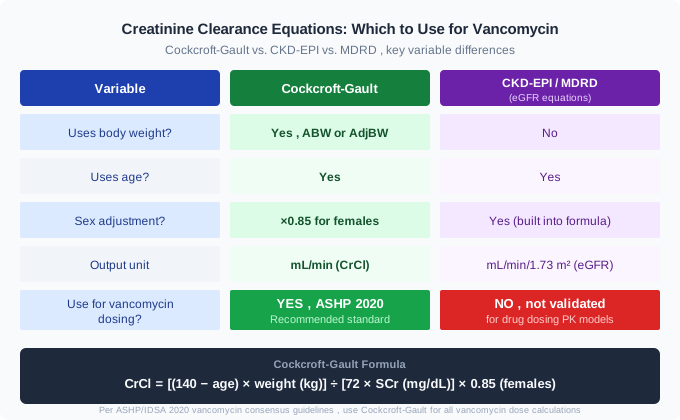
Key Differences Between the Three Equations
Cockcroft-Gault: Uses age, weight, sex, and serum creatinine. Weight-dependent. Estimates creatinine clearance (CrCl in mL/min), not GFR. Not standardized for body surface area.
MDRD: Uses age, sex, race, and serum creatinine (IDMS-calibrated). Does not use weight. Estimates GFR normalized to 1.73 m² body surface area. Tends to underestimate GFR in patients with normal or near-normal function.
CKD-EPI: Superseded MDRD for CKD staging. Uses age, sex, race (though race coefficient was removed in 2021 revision), and creatinine. Also reports GFR/1.73 m². More accurate at higher GFR values (> 60 mL/min/1.73 m²).
The absence of weight in MDRD and CKD-EPI means they don't capture the muscle mass differences between patients. That's why CG, which includes weight as a direct driver of creatinine production, was chosen for drug dosing models.
The Muscle Mass Problem
Serum creatinine is a byproduct of muscle creatine metabolism. It's not a pure filtration marker, it reflects both how much creatinine is produced (muscle mass) and how much is excreted (renal function).
This creates errors in specific populations:
Elderly patients. Sarcopenic elderly patients have low muscle mass, so they produce less creatinine. A serum creatinine of 0.9 mg/dL in an 80-year-old woman with low muscle mass may represent significant renal impairment, the CrCl by CG might be only 30–35 mL/min despite a normal-looking creatinine value. Always run the numbers; never assume normal creatinine means normal kidneys in elderly patients.
Amputees. Loss of limb mass reduces creatinine production. Using total body weight without adjusting for the missing limb overestimates CrCl. Some institutions subtract estimated limb weight (lower leg ≈ 3.7% of body weight, whole leg ≈ 16%) from actual body weight before plugging into CG.
Spinal cord injury and paralysis. Severe muscle atrophy reduces creatinine production dramatically. CrCl by CG in these patients is often an overestimate, and vancomycin accumulates more than expected.
Critically ill patients with muscle wasting. Prolonged ICU stays cause rapid muscle catabolism. A creatinine of 0.6 mg/dL in an ICU patient two weeks in may reflect severe sarcopenia more than preserved renal function.
In any of these patients, Bayesian drug level monitoring is especially important, don't trust the CrCl calculation alone.
Which Weight to Use in Cockcroft-Gault
Actual body weight (ABW) is the default for most patients. CG was derived using actual weight, so ABW is the pharmacokinetically consistent choice.
Obese patients (BMI > 30): The question is whether to use ABW, ideal body weight (IBW), or adjusted body weight (AdjBW). Vancomycin distributes into lean tissue and fat to some degree, so ABW at face value overestimates CrCl in obese patients (muscle mass doesn't scale linearly with total mass). Some institutions use AdjBW = IBW + 0.4 × (ABW − IBW) for patients with BMI > 30. Practice varies. The 2020 ASHP guidelines don't mandate a specific weight for CrCl calculation in obesity, consult local protocols.
IBW formulas for reference:
- Male: 50 kg + 2.3 kg per inch over 5 feet
- Female: 45.5 kg + 2.3 kg per inch over 5 feet
For vancomycin dose calculation (not CrCl), the 2020 guidelines recommend using actual body weight (capped at a max dose of 3000 mg per loading dose), even in obese patients. CrCl and dose weight are separate decisions.
Worked Example: CG vs. CKD-EPI in Practice
Patient: 74-year-old woman, 58 kg, height 5'3", serum creatinine 1.1 mg/dL
Cockcroft-Gault:
CrCl = [(140 − 74) × 58] / [72 × 1.1] × 0.85
= [66 × 58] / [79.2] × 0.85
= 3828 / 79.2 × 0.85
= 48.3 × 0.85
= 41.1 mL/min
CKD-EPI (2021, no race variable):
Using the standard equation for female with creatinine > 0.7 mg/dL:
eGFR ≈ 54 mL/min/1.73 m² (approximate, actual CKD-EPI calculation requires the full coefficient set)
The CG gives you 41 mL/min; CKD-EPI gives 54. That's a 13-unit difference. Based on CG, this patient gets q24h dosing (CrCl 20–49 mL/min). Based on CKD-EPI, she might get q12h. Those dosing intervals lead to meaningfully different AUC exposures. Run these numbers yourself using our dose calculator for vancomycin, it uses Cockcroft-Gault internally, as the ASHP 2020 guidelines specify.
This is not a case where either equation is "wrong", they measure different things. But for vancomycin, CG is the right tool because it's what the PK models were calibrated on.
Use our vancomycin dosing calculator to see how CrCl drives dose selection for your patient. For more on how CrCl thresholds map to dosing intervals, read our vancomycin renal dosing post.
Practical Takeaway
Use Cockcroft-Gault with actual body weight (adjusted for obesity if your institution protocols specify) to calculate CrCl for vancomycin dosing. Don't use the eGFR reported by your lab, it's CKD-EPI or MDRD, and it's normalized to 1.73 m² BSA. Use the patient's current creatinine, check the timestamp, and flag sarcopenic patients for clinical pharmacist review.
For questions about weight selection in obese patients, see our vancomycin obesity dosing post. The about page describes how this calculator applies Cockcroft-Gault internally for all dose recommendations.