Vancomycin for Endocarditis and Bone Infections
Vancomycin endocarditis dosing demands aggressive AUC targets and weeks of therapy. Learn duration, tissue penetration, and when to consider oral step-down or surgery.
Quick Answer: Target AUC₂₄ of 400–600 mg·h/L for MRSA endocarditis, but recognize that vancomycin achieves only 10–15% of serum concentrations in cardiac valve tissue. Treat for 6 weeks from the first negative blood culture for native valve, 6 weeks plus surgical evaluation for prosthetic valve endocarditis.
Vancomycin endocarditis dosing is not the same as dosing for a skin infection. The same drug, the same AUC target range on paper, but the stakes, the duration, the monitoring intensity, and the consequences of failure are categorically different. Valve infections and osteomyelitis demand that you understand not just the pharmacokinetics but also where vancomycin actually reaches in tissue and at what concentrations. The dosing framework below draws on both the 2020 ASHP/IDSA/PIDS/SIDP consensus (Rybak MJ et al., Pharmacotherapy 2020;40(13):1280–1315) for vancomycin pharmacokinetics and the AHA/IDSA endocarditis guidelines for duration and adjunctive care.
Why Endocarditis Requires Aggressive Dosing
The infected cardiac valve presents three pharmacological challenges simultaneously.
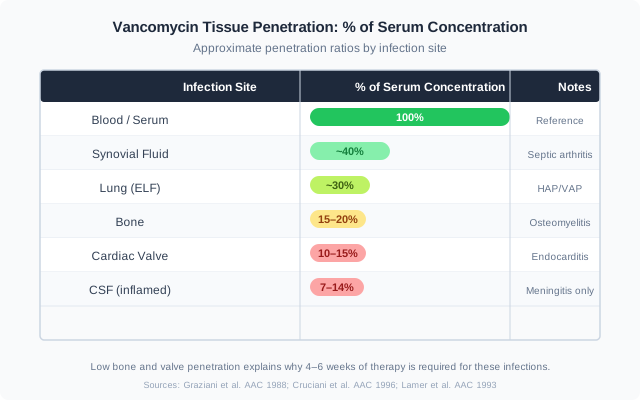
First, tissue penetration is poor. Vancomycin achieves approximately 10–15% of serum concentrations in cardiac valve tissue. For a patient targeting serum AUC₂₄ of 500 mg·h/L, valve tissue AUC is effectively around 50–75 mg·h/L. That's sufficient for bacteriostatic activity against susceptible MRSA (MIC ≤1 mg/L), but the margin is narrow.
Second, bacterial burden is high. Mature valve vegetations are densely packed with organisms, often exceeding 10⁹ CFU/g, embedded in fibrin-platelet matrices that physically limit drug penetration. Gram-positive organisms deep in a vegetation may be exposed to drug concentrations far below the MIC even when serum levels look adequate.
Third, bactericidal activity is required. Endocarditis is not an infection you can manage with bacteriostatic suppression. You need to kill the organisms, which for vancomycin against MRSA means achieving AUC/MIC ratios well above the minimum threshold for efficacy. Read more about this framework in our AUC/MIC ratio discussion.
These three factors together explain why the 2020 ASHP/IDSA guidelines, while maintaining the 400–600 mg·h/L AUC target across serious MRSA infections, support targeting the upper end of that range (500–600 mg·h/L) for endocarditis. It's not that the nephrotoxicity ceiling moves; it's that the clinical risk of underdosing is particularly high when the site of infection is a heart valve.
Duration: Native Valve vs Prosthetic Valve
Duration is one area where endocarditis is unambiguous: it takes weeks, not days.
Native valve MRSA endocarditis is treated with 6 weeks of vancomycin in most guidelines. The AHA/IDSA 2023 infective endocarditis guidelines recommend 6 weeks for complicated cases and allow 4–6 weeks for uncomplicated right-sided endocarditis in injection drug users if the clinical response is rapid and favorable. The Duke criteria define "uncomplicated" narrowly, no embolic events, no perivalvular extension, no paravalvular abscess, prompt bacteremia clearance.
Prosthetic valve MRSA endocarditis is treated with a minimum of 6 weeks of vancomycin. The 2023 AHA/IDSA guidelines recommend considering adding rifampin (600 mg/day, or 300 mg every 8 hours) and gentamicin for the first 2 weeks in prosthetic valve endocarditis. Rifampin has biofilm-active properties against staphylococci that vancomycin lacks, this combination is one of the few cases where gentamicin is deliberately combined with vancomycin despite the additive nephrotoxicity risk.
During a 6-week course, the patient's renal function will change. TDM is not a one-time event; it's a repeated process throughout therapy. AUC re-estimation should be triggered whenever creatinine changes by ≥0.3 mg/dL, not just at week-1 steady state. Use our vancomycin dosing calculator to recalculate AUC with updated renal function throughout the course.
Bone and Joint Infections: Penetration and Duration
Vancomycin's penetration into bone is 15–20% of serum concentrations based on tissue sampling studies by Landersdorfer et al. (2009, Antimicrobial Agents and Chemotherapy) and others. Synovial fluid penetrates better, approximately 40% of serum. This gradient matters for how you approach osteomyelitis versus septic arthritis.
Osteomyelitis generally requires 4–6 weeks of IV antibiotic therapy. The 6-week duration comes from historical surgical data showing that shorter courses were associated with higher relapse rates in staphylococcal osteomyelitis. For MRSA, vancomycin AUC-guided dosing targeting 400–600 mg·h/L is standard. The OVIVA trial (2019, NEJM) demonstrated that oral step-down after initial IV therapy was non-inferior for bone and joint infections broadly, but that trial did not specifically validate oral options for MRSA osteomyelitis, and the oral step-down alternatives have important limitations (see below).
Septic arthritis from MRSA can often be managed with a shorter total duration, 3–4 weeks, but requires adequate source control through joint drainage. Serial joint aspiration or surgical washout is an integral part of treatment, not just a diagnostic maneuver.
One nuance in septic arthritis management: the joint space is not sterile after washout, and residual drug penetration through the synovial membrane is needed to clear residual organisms. Given the ~40% synovial penetration, serum AUC targets in the middle of the therapeutic range (450–550 mg·h/L) are appropriate.
Oral Step-Down Therapy: What's Actually Viable for MRSA
Vancomycin has zero oral bioavailability for systemic infections, oral VAN is used only for C. difficile colitis, where local gut concentrations are the goal. For MRSA osteomyelitis and endocarditis, step-down to an oral agent requires a drug with both adequate bioavailability and MRSA activity.
Three agents are commonly discussed:
Linezolid (600 mg PO q12h) has excellent oral bioavailability (≈100%) and reliable MRSA activity. It achieves bone concentrations approximately 40–50% of serum. The IDSA 2011 osteomyelitis guidelines list it as an alternative for MRSA. The limitations: cost, the risk of serotonin syndrome with concurrent serotonergic medications, myelosuppression with prolonged use (>4 weeks), and the risk of peripheral neuropathy. Weekly CBC monitoring is standard. Despite the monitoring burden, linezolid is the most validated oral option for MRSA bone infections.
Doxycycline and co-trimoxazole (TMP-SMX) are frequently used for MRSA skin and soft tissue infections and have been used as oral step-down for some outpatient MRSA bone infections. But neither has been validated in prospective controlled trials for MRSA osteomyelitis, and neither is recommended in IDSA guidelines as a primary option for serious MRSA bone infections. Use with caution and ensure susceptibility is confirmed.
These agents are not appropriate for MRSA endocarditis step-down. The clinical risk of oral therapy for endocarditis is substantially higher than for bone infections, and IV therapy should be completed in full.
When to Consider Surgery
Antimicrobial therapy alone is insufficient in several scenarios:
Endocarditis indications for surgery (per 2023 AHA/IDSA guidelines) include: severe valvular dysfunction causing heart failure, periannular abscess or fistula, persistent bacteremia after 5–7 days of appropriate therapy, large vegetations (>10 mm on anterior mitral leaflet with prior embolic events), and fungal or highly resistant organisms. Surgery during active endocarditis carries significant operative risk, but delaying necessary surgical intervention increases mortality.
Osteomyelitis indications for surgery include: hardware infection (particularly orthopedic hardware, screws, plates, joint prostheses), sequestrum formation (dead cortical bone that acts as a bacterial nidus), failed conservative therapy after 6 weeks of IV antibiotics, and chronic osteomyelitis with cortical involvement requiring debridement. For diabetic foot osteomyelitis, surgical debridement significantly shortens required antibiotic duration in observational studies.
The MRSA treatment guidelines on this site discuss the broader framework for selecting appropriate therapy and when to escalate, see the MRSA treatment guidelines post for more detail.
Practical Monitoring Throughout a Long Course
A 6-week course of vancomycin for endocarditis or osteomyelitis means the patient's renal function, volume status, and concurrent medications will all change. Static dosing based on initial AUC estimation fails about 40% of patients by the end of a 6-week course, based on pharmacokinetic modeling data.
The monitoring approach that works:
- AUC estimation at steady state (after 3rd or 4th dose for patients with stable renal function)
- Serum creatinine every 48–72 hours for the first 2 weeks, then at least twice weekly thereafter
- Repeat AUC estimation whenever creatinine changes significantly, clinical status changes (septic shock, volume resuscitation, renal injury), or if clinical response is inadequate
- Trough-only checks as a rapid safety screen between formal AUC estimations, a trough rising above 25 mg/L warrants urgent AUC re-evaluation
The goal throughout is to keep AUC₂₄ in the 400–600 mg·h/L range for the entire duration, not just at week 1. Use the estimate your vancomycin dose tool with updated patient data at each reassessment point to make sure the current dose is still appropriate.
Endocarditis and osteomyelitis are prolonged battles. Vancomycin can win them with appropriate dosing, monitoring, and source control, but it needs pharmacist attention throughout the entire course, not just at initiation. See who we are and how this tool was built for background on the clinical approach behind our calculator.